Searching for the Remains of Paradise in Weda Bay (Part 2)
FAILED to find a fish paradise in ring 1, we looked for what might still be left in ring 2. We went to Sagea.
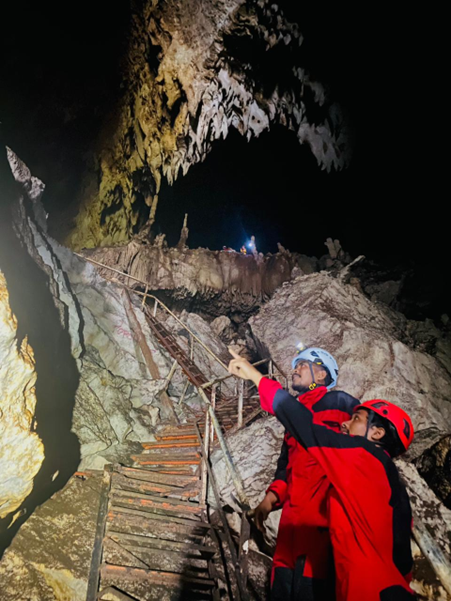
On land, Sagea still maintains its lake and Boki Maruru Cave. Here, you can see the beauty of stalactites and stalagmites, along with a clear underground river, typical of karst regions.
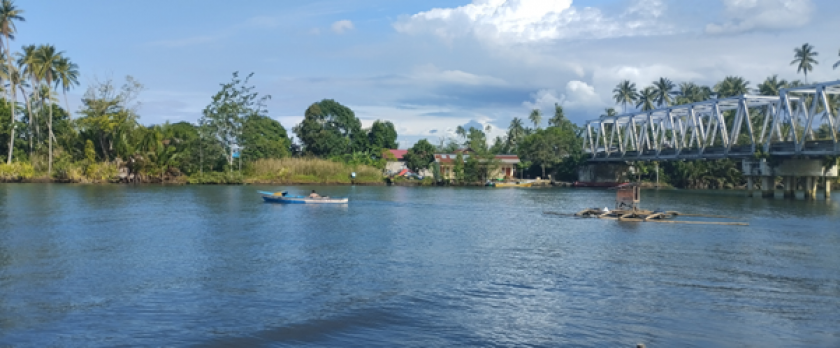
However, this location is also under threat. The river has reportedly been frequently muddied by mining activities. To date, around six mining permits have been issued in the Sagea watershed, including those for PT Harus Sukses Mineral, PT Weda Bay Nickel, PT Dharma Rosadi Internasional, PT First Pacific Mining, PT Gamping Mineral Indonesia, and PT Karunia Saga Mineral. Most of these permits are integrated with IWIP.
So what about the condition of the waters off Sagea?
There's Sentuli. This is a curve of the Sagea coastline that remains a popular fishing destination for fishermen, especially those with boats without engines. It's about 2 km from the settlement.
As with other locations, catching bottom fish is very difficult because the coral reefs here have become sedimented. In Sentuli, fishermen can only catch a variety of surface fish that appear in these waters every afternoon.
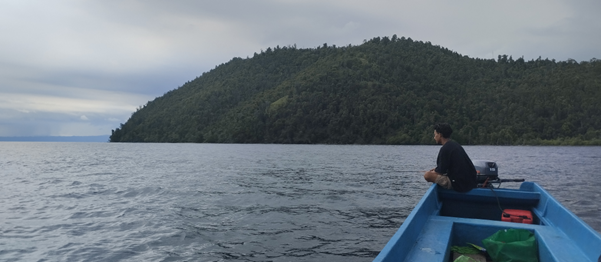
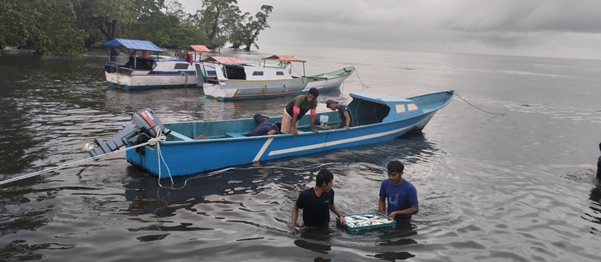
Towards Sentuli, the origin of all the fish in Sagea (Photo: Auriga)
Supriadi, a Save Sagea activist, explained that before sedimentation, the coral reefs in Sentuli were very healthy. Various types of demersal fish, such as grouper, red snapper, and kurisi, were easily found. In the past, fishermen in Sagea and Kiya didn't have to travel far to fish. "Now it's no different from other places in Weda Bay; it's difficult to catch fish, especially demersal fish," he said.
Regarding the cause of the sedimentation, he blamed the mine integrated with IWIP as the sole source. "Nobody in the community has the skills to mine or open illegal mines," he said.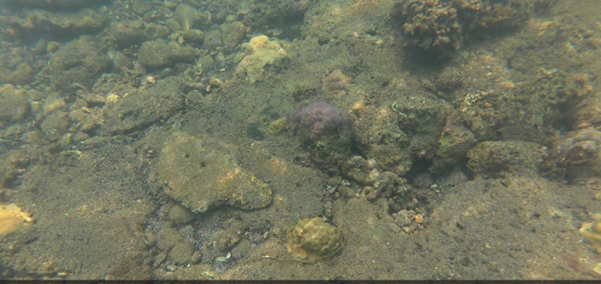
The majority of Sagea residents have long relied on gardening and fishing as their primary livelihood. From January to August, due to rough seas, they go to work in the fields, and then, starting in September, when the sea calms down, they go to sea.
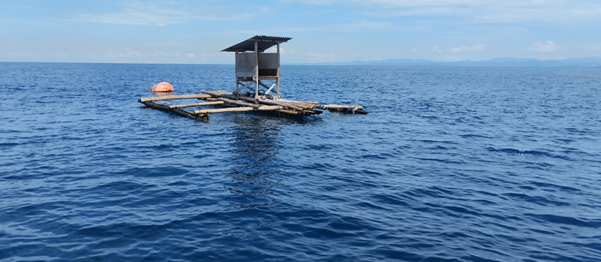
To maintain their fishing income, Sagea fishermen are forced to work around this by constructing fish aggregating devices (FADs). The average distance of these FADs is 10 kilometers from the coastline. Besides the additional cost of transporting fuel to the FADs, the cost of constructing the FADs is also significant.
Hasan, a Sagea fisherman, said that constructing one FAD costs at least IDR 3 million. He said there are currently 25 fishing FADs in Sagea waters. Some have been damaged or even lost after being struck by ships.
"If we don't build FADs, we might not catch any fish," Hasan said.
Although not as severe as Lelilef, pollution in Sagea is also felt by fishermen. At least two kilometers from the Sagea coastline, the waters are polluted by sedimentation, which can inhibit the growth of and even damage coral reefs and mangroves.
This condition is confirmed by data from the North Maluku Regional Development Planning Agency (Bapeda), which states that the coral reefs in North Maluku, covering an area of 107,434.2 hectares, are largely in poor condition. As of 2022, Central Halmahera ranked second (30%) in terms of coral reef damage. The cause of the damage was identified as destructive fishing using bombs and poison. Another cause is the frequent use of coral reefs for land-based construction. Other causes of damage, such as mining, were not mentioned.
According to Dr. Abdul Motalib Angkotasan, S.Pi, M.Si, a lecturer in the Marine Science Study Program, Faculty of Fisheries and Marine Sciences, Khairun University, Ternate, stated that to date, there has been no in-depth study on the damage to essential marine ecosystems (coral reefs) caused by nickel mining, including at IWIP.
However, he has studied coral reef damage caused by nickel mining on Pakal Island, East Halmahera. He noted high levels of Total Suspended Solids and Total Organic Matter. This condition threatens coral life and causes habitat changes due to the high rate of algae growth caused by the abundance of nutrients in the water. The situation on Pakal Island could be even more dire considering the large-scale exploitation of nickel materials in Weda, which has been underway since 2018.
This is projected to impact the sustainability of coral reef ecosystems, as their waters are under pressure from the influx of sediment from the mainland. Furthermore, the conversion of mangrove forests in industrial areas has contributed to the reduction of their role and function as natural buffers for sedimentation from land to coastal and marine areas.
If the nickel industry's growth cannot be stopped, in the future the remaining fish paradise in Weda Bay will only be a story.